





On July 17, 1871, the English poet and artisan William Morris set out from Reykjavík on horseback with three companions, two guides, and fourteen ponies on the first leg of a six-week journey through the heart of western Iceland. In the age of steamships, locomotives, and the telegraph, this mode of travel was medieval by comparison. Morris and his party threaded their way from one homestead to the next, relying on the hospitality of landowners and priests, or, just as often, wilderness camping, hunting and fishing for dinner. They forded treacherous rivers, crept along coastal cliffs, and braved the howling blasts of highland passes, embracing levels of discomfort and risk that would daunt most 21st-century tourists.
Today, Morris is best remembered as the hand behind the flourishing organic patterns of Morris & Co. wallpaper, and for his leading role in reviving pre-industrial handicrafts; in his day, however, Morris was one of Britain’s leading poets, renowned for poems like his epic mythological compendium, The Earthly Paradise (1868). Starting in 1868, Morris took lessons in Old Norse from Eiríkur Magnússon, an Icelandic literary scholar with a position at Cambridge. These reading sessions developed into a collaboration, yielding the first English translations of three major sagas: Gunnlaug Wormtongue (1869), The Story of Grettir The Strong (1869), and The Story of The Volsungs and Niblungs (1870), along with a number of Eddic poems. Eiríkur furnished Morris with literal translations, and Morris reshaped them in his own style, stressing the Germanic roots of English to capture the feeling of Old Norse.
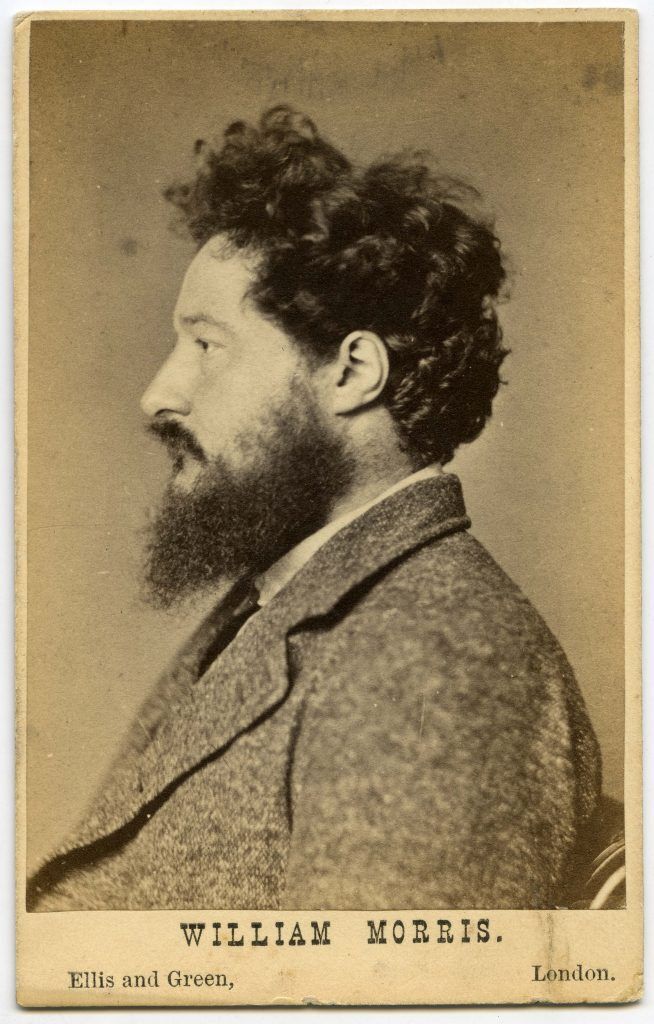
This joint project culminated in the Iceland expedition: a journey to the source. Eiríkur helped Morris plan a route through the Western “saga-steads,” and wrote to his extensive network of contacts, securing promises of lodging for their four-man group, including Morris’s old friend Charles Faulkner, and the outdoorsman W.H. Evans. At the end of each day, Morris took detailed notes, eventually writing them up as A Journal of Travel in Iceland (1873). As with his translations, Morris tried to capture the common root of English and Icelandic, translating Icelandic place names into archaic compound words, and locally specific words into their archaic English equivalents (bóndi = “bonder,” i.e., landowning farmer; staður = “stead,” i.e. homestead).
The land defied Morris’s wildest expectations, and at first, he was taken aback. Influenced by Romantic associations of nature with beauty and pleasure, he saw the island’s severe volcanic landforms and looming glacial masses as unbeautiful and menacing. However, Morris was already straining at the bounds of Romanticism. He sought a new aesthetic language, something sterner and bolder, and in this daunting landscape, he found it. The harsh majesty of Iceland pushed Morris to fully overcome Romantic notions of the relationship between nature and humanity, transforming his perception of the outlaw hero Grettir.
Composed later than most other classic sagas, during the fourteenth century, Grettis saga immediately spoke to Morris’s love of medieval romance. Where family sagas like Njáls saga trace intergroup conflicts from generation to generation, registering deeds with the hard impersonality of the Viking Age, Grettis saga colourfully relates the life of a charismatic, well-rounded individual – not just a brawler, but a defender of the helpless, a composer of poetic insults, and a haunted, tragic figure. Grettir rises from shiftless youth to win great glory as a duelist and monster slayer until a ghost curses him, and his luck runs out. Grettir’s insatiable appetite for mayhem has always caused problems, but now it gets him condemned to full outlawry, giving his enemies free rein to hunt him down. Grettir holds out for fifteen years, “the longest in outlawry of any man,” until his foes resort to foul sorcery. Morris admired Grettir’s stoic strength in the face of exile and hardship, and felt he knew him well. In a poem prefacing his translation, Morris insists that Grettir lives on through the tale, as a “friend to me, life’s void to fill.” In a way, Morris’s Iceland journey is a search for Grettir. When Morris does at last “find” his friend, however, he is profoundly unfamiliar.
Strangeness in motion
Morris’s four-man party embarks from northern Scotland on July 8, steaming out of Granton Harbour aboard the Diana, then turning northeast between the Orkneys and the Shetlands. After several more days, with an afternoon stop in the Faroes, they reach the southeastern coast of Iceland. Dropping anchor at Deepbay (Djúpivogur) for an exchange of passengers and letters, they round the coast to the southwest, stopping once more at the Westman Islands before finally arriving in Reykjavík.
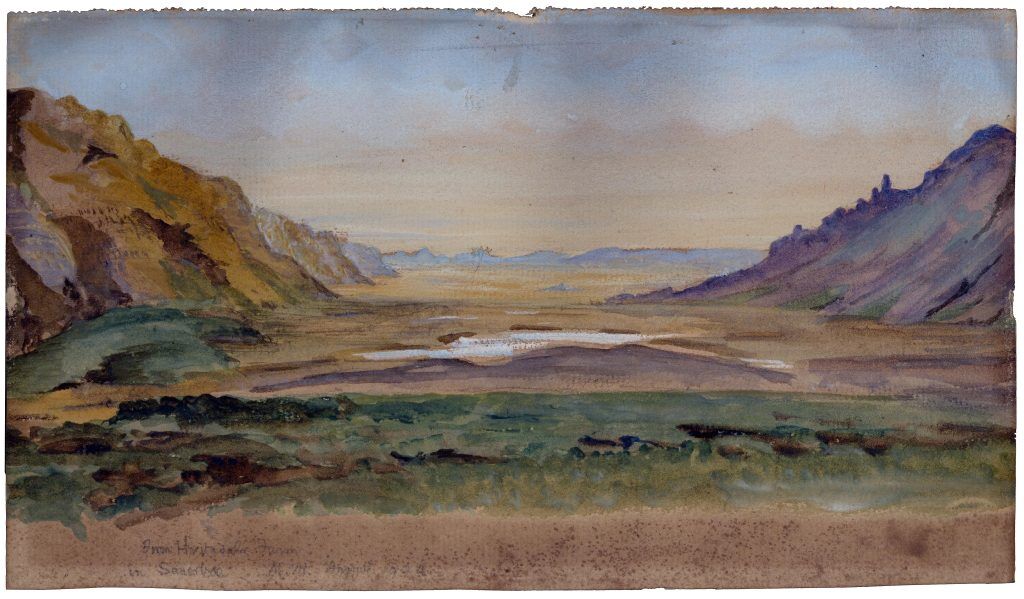
When they strike out from Reykjavík on July 17, Morris sees the countryside around him as “strange and awful… in spite of all my anticipations: a doleful land at first with its great rubbish heaps of sand, striped scantily with grass sometimes.” Used to the greenery of English fields, forests, and the Romantic equation of nature with teeming life, Morris cannot help judge his new surroundings by these standards. But after a fortifying champagne toast, he begins parsing the rapidly changing landscape with enthusiasm:
[We] came on to the lava itself, grown over here with thick soft moss, grey like hoar-frost: this ended suddenly in a deep gully, on the other side of which all was changed as if by magic, for we were on a plain of short flowery grass as smooth as a lawn, a steep green bank bordering it all round, which on the south ran up into higher green slopes, and these into a great black rocky mountain: we rode on over the east side of the bank, and then again a change: a waste of loose large-grained black sand without a blade of grass on it, that changed in its turn into a grass plain again but not smooth this time; all ridged and thrown up into hummocks as so much of the grass land in Iceland is, I don't know why: this got worse and worse till at last it grew boggy as it got near another spur of the lava-field, and then we were off it on to the naked lava, which was here like the cooled eddies of a molten stream.
This description is remarkably dense, especially given it covers only an hour or two of riding. We can see his tapestry-weaver’s eye for texture and colour as he carefully notes each unit of the sequence before it “changes” into the next. The speed of these changes suggests a rippling movement of the land itself, as if the geological processes that shaped it were unfolding before Morris’s eyes: torrents of lava clash and cool, one layering over the next, until glacial torrents and heavy rain erode them, the swollen sea deposits black sands, and mosses weave themselves into broken surfaces. Morris begins to see Iceland’s inorganic substratum not as “doleful” and dead, but as energised, erupting into life.
Exile on the eagle’s heath
Morris and his companions thread a crooked figure eight throughout western Iceland. First, they ride southeast along the river-riven shore, then climb to the major steads of Njáls saga, Bergthorsknoll (Bergþórshvoll) and Lithend (Hlíðarendi). From here, they detour to the hidden valley of Thorsmark (Þórsmörk), now one of Iceland’s most popular hiking destinations, but then, a personal obsession of their saga-learned guide, Jón. After this, they head northwest on the first leg of an overland trek.
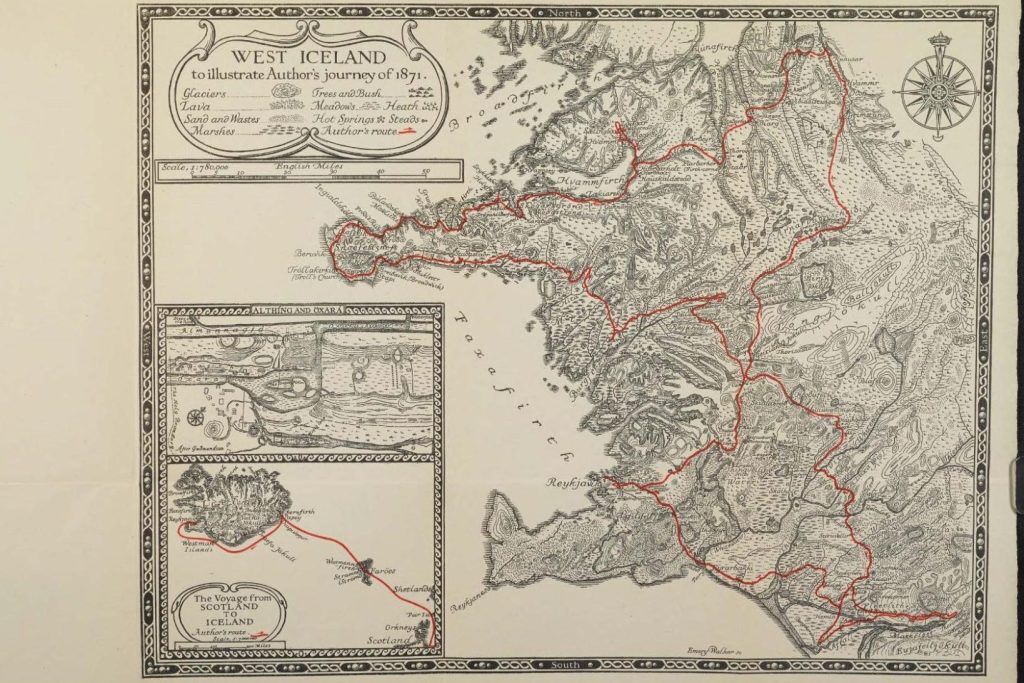
Traversing the central highland over broken lava and black sand, they camp at Brunnar, then make for the mountain road of Cold-dale (Kaldidalur). They pass through glacial gates, gradually descending to Grettir’s most lonely hideout, Ernewaterheath (Arnarvatnsheiði), or in more modern English, Eagle-water Heath:
It is a big sheet of water, some seven miles square with low hills all round it, and between us and it a stretch of boggy land that runs at last in a long spit into the lake: this is Grettirs-head where he lived at the time he slew Thorir Red-beard his would-be assassin; it is a most mournful desolate-looking place, with no signs of life as we rode up but for a swan that rose up trumpeting from the lakeside.
Looking out on this vast wetland, Morris can sense Grettir’s total isolation. He feels the full weight of the saga’s terse remark: “dreary he deemed it… because he was so fearsome of the dark,” that “hardly might he bear to be alone.” Morris must have struggled to reconcile the sheer bleakness of the place with a dawning realisation that, despite Grettir’s loneliness, he was basically at home. Working with the seemingly hostile terrain, the hero foils attempt after attempt on his life. When Þórir Redbeard attacks him as he comes ashore, Grettir falls backwards into the lake, as if dead, then swims deep along the shoreline to a creek at Þórir’s back. Rising like a drowned man from the current, Grettir “heaves [Þórir] up over his head, and casts him down so hard that the short-sword flies out of his hand.” When another Þórir, the chieftain who outlawed Grettir, arrives with 80 men, the hero withdraws to a narrow pass, ready to make his last stand. As he cuts down foes to the front, some sneak around to attack from behind, but never make it, dropping dead or staggering from the pass with grievous wounds. Þórir calls off his men, exclaiming that Grettir must be a sorcerer, summoning “trolls” to guard the pass. The chieftain is not entirely wrong. Grettir’s mysterious ally is no troll, but the noble mountain spirit, Hallmund, repaying the hero for his kindness. In the form of Hallmund, the wilderness itself rises up to aid the outlaw.
Outlaw’s fortress, giant’s temple
From Ernewater, the party rotates west around the northern saga-steads, including Bjarg, Grettir’s family home. After a bracing circumnavigation of Snæfellsnes peninsula, they approach Grettir’s hideout on Fairwoodfell (Fagraskógarfjall), a mountain spine defining one side of a valley. Morris and his party ride along this ridge and up the valley, until suddenly, they see “a spur rushing at right angles out from the mountains, a great ruin spoiling the fair green slopes.” This is “a huge slip of black shale, very steep, and crested by thin jagged rocks, like palings set awry… under these… was Grettir’s-lair, and it was down this slip he rattled after the braggart Gisli.” This natural fortress is “such a savage dreadful place, that it gave quite a new turn in [his] mind to the whole story, and transfigured Grettir into an awful and monstrous being, like one of the early giants of the world.”
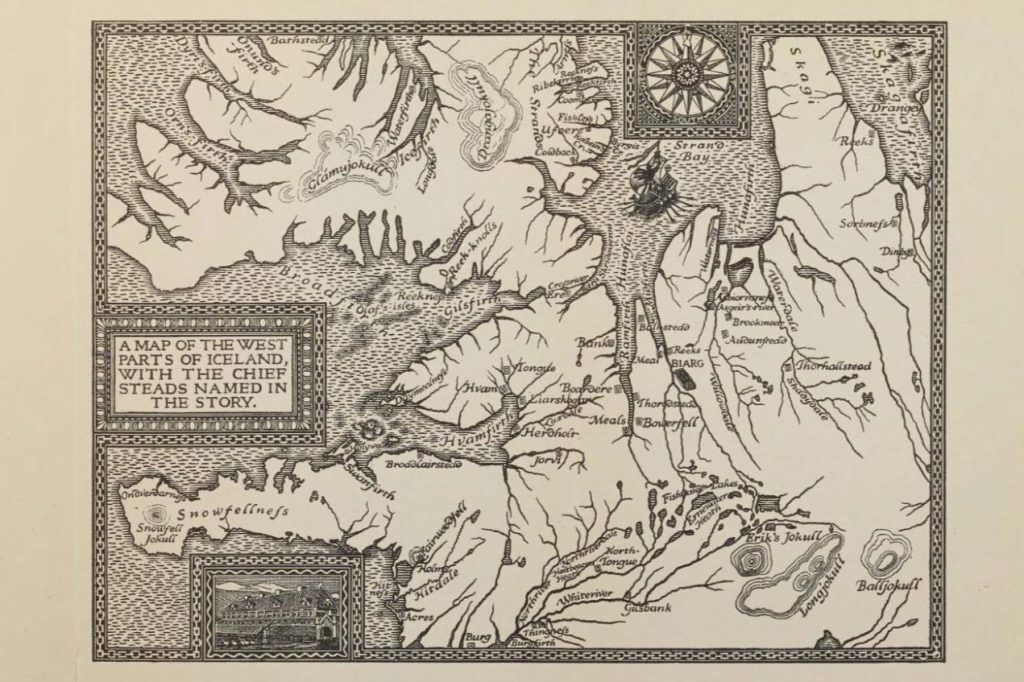
This dramatic “new turn” in Morris’s idea of Grettir depends on the whole of his journey up to this point. Throughout, Morris has been morbidly obsessed with the strangely shaped volcanic rocks that loom over the landscape, poetically perceiving them as the work of giants. When he first sights the coast of Iceland from the deck of the Diana, he sees “the mainland, a terrible shore indeed: a great mass of dark grey mountains worked into pyramids and shelves, looking as if they had been built and half-ruined.” From here on, Morris matter-of-factly refers to Iceland’s “pyramids,” and to “horrible winding streets” in the mountain walls, which disturb him even more than the pyramids. Accustomed to the rolling hills and winding rivers of England, Morris is completely unprepared for such severe regularity of form. With their clean lines, sharp angles, and sheer plunges, the “pyramids” and ”streets” radiate violence, stony hostility to the organic order. If these were once “built,” they must have been built by huge, inhuman hands. Morris makes this metaphor explicit in the poem “Iceland First Seen,” where he calls the mountain Búlandstindur “the building of gods that have been.” On Snæfellsnes, Morris finds his metaphor confirmed in local place names like Tröllakirkja, or “Troll’s Church,” and Kirkjufell, or “Church Mountain.”
Now, with Grettir’s lair before him, Morris’s entire web of associations crystalises. The outcrop becomes another “great ruin” of titanic architecture. Though not as crisply outlined as the pyramids, it too has an uncanny regularity, jutting out at a right angle from Fairwoodfell. It too attacks the organic order, biting into the “fair green slopes.” For Morris to envision Grettir here, is to place him in the castle of a giant, as a giant.
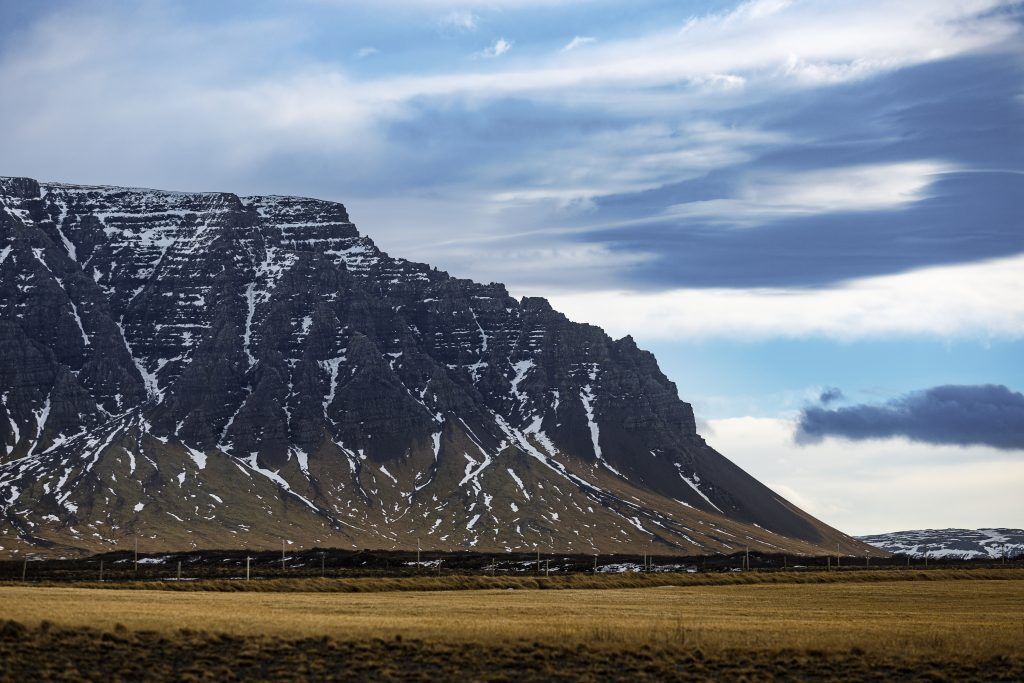
To call Grettir “awful” and “monstrous” might seem like a harsh reversal on Morris’s part, but for Victorian readers, these terms had broader meanings, less damning and more descriptive. Morris suddenly sees Grettir as massive and ferocious, distorted in form, stretched beyond the limits of the human in a way that inspires awe. He belongs not so much to the Middle Ages, as to the “monstrous order” of pagan myth. Specifically, Grettir resembles the jötnar of Norse religion, giants of fire, ice, and stone, embodiments of lawless elemental force. Morris shows us Grettir as a hulking emanation of the rock, looming out from his lair. Just as the rock spur “rushes out” from the main ridge to “spoil” the valley, Grettir “rattles down the slip” to fight his foe, projecting geologic power in real-time. This vision sweeps away Morris’s notion of the outlaw as a Romantic hero, defined by unique yet quintessentially human psychology. Grettir is now less than individual, and more than human. His monstrous strength arises from the very earth, his motives are instinctive and his deeds irresistible.
A monstrous defender
Morris’s vision of the hero as a giant has implications that ripple outward through Grettis saga, activating its pagan subtext. In other words, certain things start to make sense. Grettir is described as handsome, but in a broad and blocky-featured way, and unusually massive. In the saga, he tests his strength by throwing huge stones, but when Morris sees the traditional site of a “Grettir’s Heave” at Bjarg, his friend Faulkner estimates the boulder’s weight at a colossal twenty tonnes. When Grettir dwells at Fairwoodfell, he often descends from his mountain cave to plunder the surrounding farms, just like a giant. The locals, helpless to stop his raids, “deem that a woeful guest had come among them,” exactly how they would respond to the ravages of a giant.
We can think of Grettir as a kind of anti-giant, born from raw elemental forces, but fighting to defend the human world from those forces. He is patterned on the champion-god Þór, special enemy of giants who, in his vast strength and earthy solidness of character, greatly resembles them. Where the jötnar threaten the garður, the walled enclosure of the world, Þór defends it. As a child, however, Grettir is no Þór. He indulges in monstrous violence, protesting chores by wringing the necks of a flock of goslings, and flaying a horse alive. His dangerous tantrums persist until checked by the counter-pressure of men he respects. From this point until his outlawry, Grettir turns his monstrous strength to (mostly) prosocial ends, chiefly against other unruly beings of the old order. He subdues a barrow-dwelling wight, slays rampaging berserkers, and challenges Glámur, a revenant whose undeath raises him to giant size. Glámur struggles to pull Grettir over the threshold into the yard, where his power will grow, while Grettir struggles to keep Glámur inside the domestic garður, where he has the advantage. Each is tied to territory, the ghost and hero facing off as giant and Þór. After smiting Glámur and incurring his curse, Grettir does one last monster-slaying deed, overcoming a true giant. He dives into a canyon, swims beneath a crushing waterfall, and enters a hidden cave, confronting the giant on his home turf. Nevertheless, the hero wins handily, proving himself a match for giants, and a master of their subterranean domain.
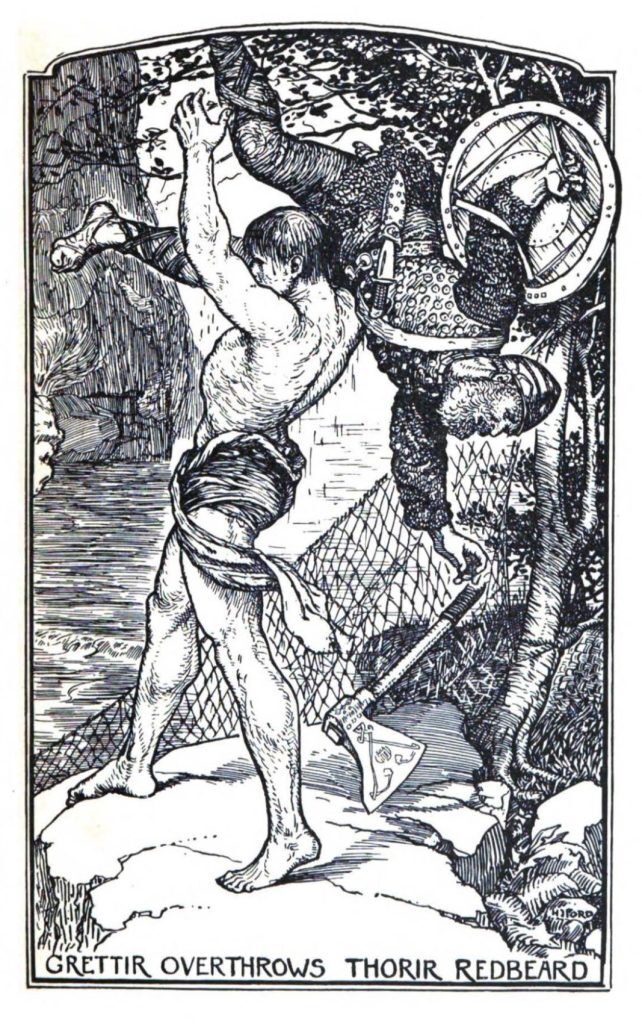
If Grettir’s enemies are all giant-like, so are his friends. Grettir’s only real peer, the one warrior who can best him, is Hallmund, who rescues him on Ernewaterheath. Though the saga never calls Hallmund a giant, he is “huge to behold on horseback.” He hosts Grettir in a “huge cave” under the glacier Balljökull, with his “daughter great of growth and of high mind,” reminiscent of giantesses wooed by the gods in the Poetic Edda. Hallmund shows Grettir a hidden place to winter, a geothermally-heated paradise called Þórir’s dale. There, the hero is welcomed by the “half-troll” or “giant” Þórir and his beautiful daughters, proving himself a match for them in the Romantic sense. Always a fish out of water in the human world, Grettir is only truly at home among the spirits of the land. Grettir’s tragedy is that, under the weight of outlawry, he becomes less of a Þór, and more of a giant, living beyond the walls and taking what he will. Grettir raises himself up from the earth and subsides into it, like a human rock formation, ultimately meeting his end on the stony shores of Drangey.
All this insight into the metaphysical dimension of the saga stems from Morris’s journey through the Icelandic wilds. He learns to cast off old Romantic notions of a nourishing, humanised nature, and yet to honour nature for what it is: the interweaving of forces which we, like Grettir, can strive to emulate. Though Morris faces Grettir in all his strangeness, he does not forsake his hero. Rather, he doubles down. Morris dedicates himself to Grettir’s grim ethos, “the worship of courage,” with such conviction that he becomes a stranger to his own age. The voyage to Iceland acquires the significance of a pilgrimage, affecting Morris so deeply that, towards the end of his life, he declares himself “a pagan.” All this feeds into his masterpiece, The Story of Sigurd The Volsung and The Fall of The Niblungs (1876), where he rewrites the prose of the Völsunga saga as an epic poem, in the manner of Homer’s Iliad.
Walking with Grettir
From Fairwoodfell, Morris and his party head southeast to Burgfirth (Borgarfjörður), and begin the last leg. They soak in the geothermal bath of Snorri Sturlusson at Reykholt, and linger on the mighty plain of Þingvellir, before riding into Reykjavík on August 28. Once daunted by Iceland’s “terrible shore,” Morris has come to know it as “a marvellous, beautiful and solemn place.”
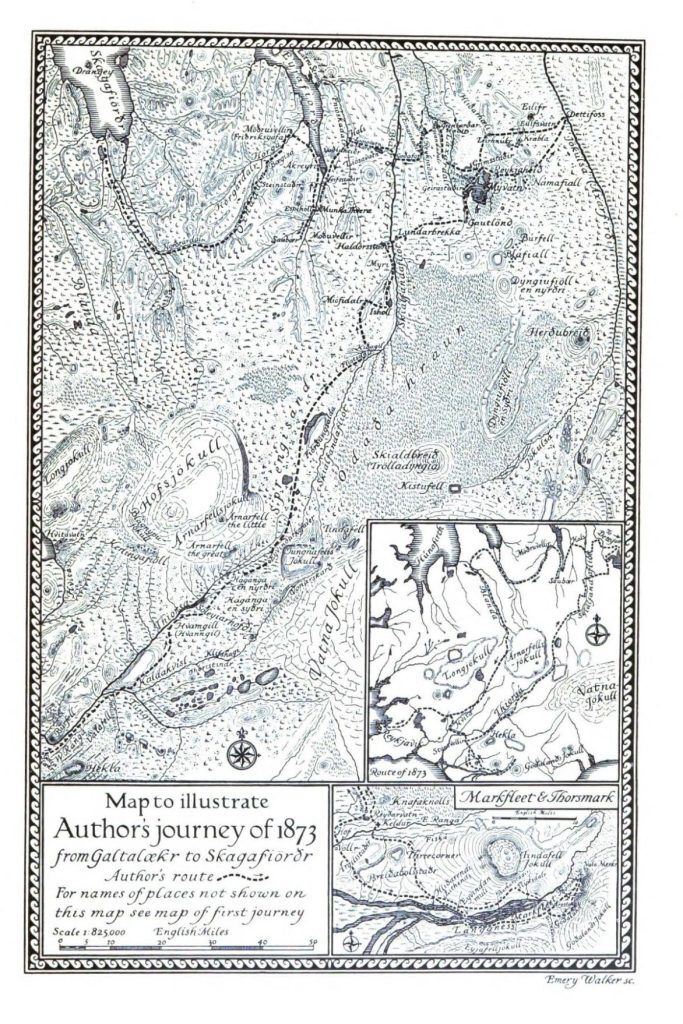
Morris makes one more trip to Iceland in July 1873, accompanied only by Faulkner. They take an even more arduous path, the highland road northeast to Dettifoss. Morris keeps another journal, which quickly breaks up into fragments, then goes silent. May Morris, her father’s posthumous editor, suggests he is “entirely absorbed” into the countryside, having “shaken off his human sympathies.” He goes with his friend Grettir, and walks amongst the spirits of the land.
